What actually makes a website readable to AI?
Getting found now means being readable to AI, not just Google. Here's a way to find out how your site measures up.

Not long ago, getting found online meant ranking on Google. Today, more and more people skip the search results and just ask an AI assistant: “who’s a good accountant near me?” or “what should I know before hiring a roofer?” The assistant reads the web and answers in a sentence or two.
That changes the job your website has to do. It still has to make sense to the people reading it. Now it also has to make sense to the machines reading it on their behalf. So what actually makes a site readable to AI? I spent six months and nine live audits figuring that out, and got it wrong a few times before it started to feel right. The result is the Frilly Readability Score you can run your website through, starting today.
What the Frilly Readability Score is
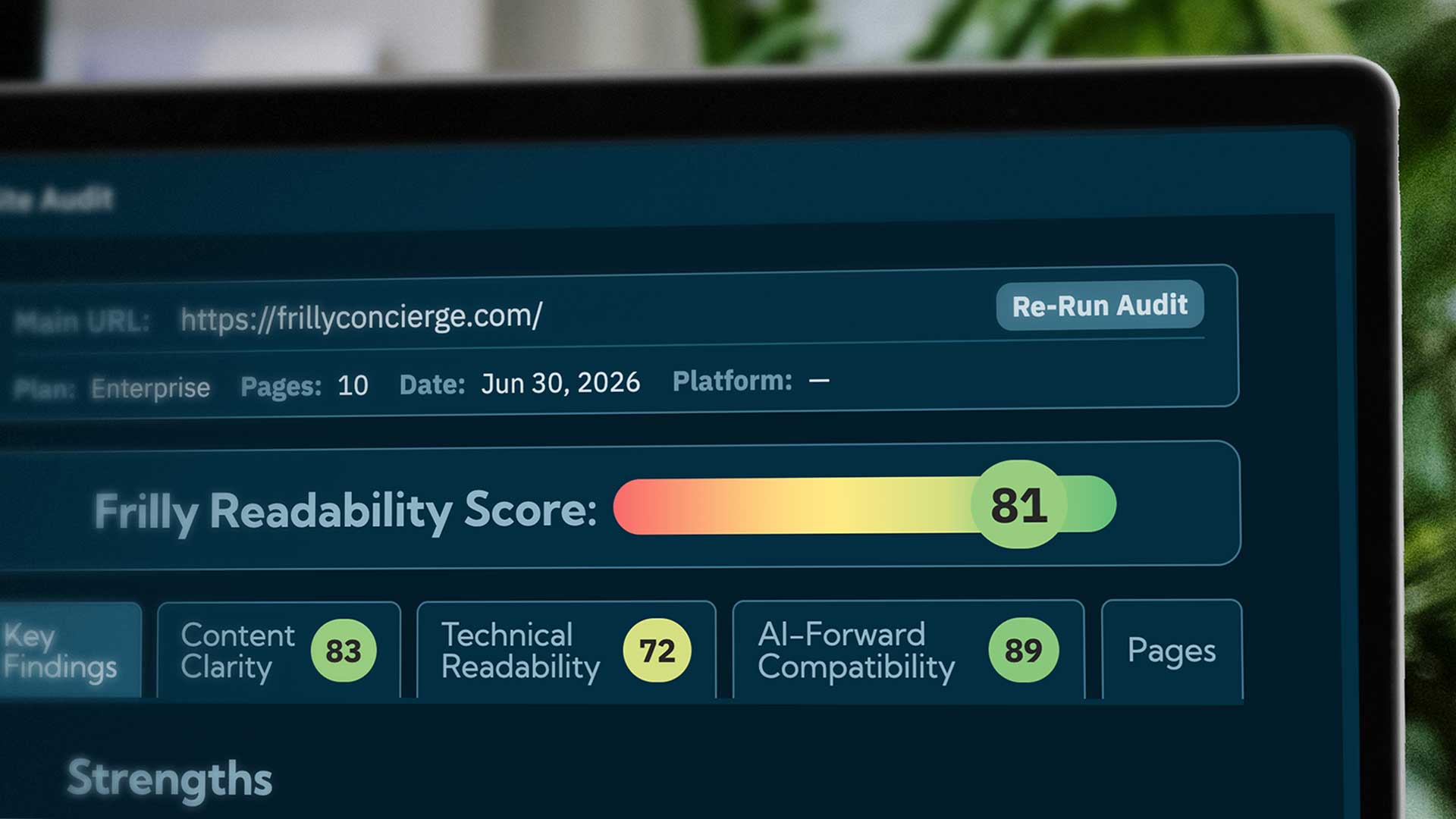
The Frilly Readability Score (FRS) is a measure of how well a website communicates: to the people reading it, to the search engines that index it, and to the AI assistants that increasingly read it on a person’s behalf. It is produced by an audit that reads your pages and scores them across three lanes, and it returns a single 0 to 100 score, a score for each of the three lanes, and plain-language findings on where you stand.
It is a readiness score, not a promise. It tells you how legible your site is today and what to improve first. It does not guarantee that any search engine or AI system will feature you, because no honest tool can.
Large enterprises are already investing to stay legible in this shift. Most local businesses are not, because they have no content team and no budget for it. The Frilly Readability Score exists to close that gap: to give a small operation a clear, honest read on how ready their site is, and a concrete path to improve.
First, what “readable to AI” does not mean
It is not about stuffing in keywords, hiding a pile of code, or gaming a system. The research on how AI actually reads the web points the other way. Modern AI relies far more on meaning than on keyword matching alone. It reads for meaning, context, and relationships, more like a careful human reader who happens to read millions of pages at once.
So the most powerful thing you can do is also the most old-fashioned: write clearly. Say what you do, who it is for, and why it matters, in plain words a real person would use. Clear content is what every machine, from Google to ChatGPT, understands best.
The three things that make a site readable
In the context of the audit, “readable” is split into three honest layers. Each one serves a different reader.
1. Content clarity, for humans and AI alike. This is your actual writing. Can a first-time visitor, or an AI reading for them, tell what you offer without guessing? This is the foundation, and the one layer you control with words alone.
2. Technical readability, for search and answer engines. This is your structured data: behind-the-scenes labels (called schema) that give search engines like Google, and potentially answer engines like Perplexity, standardized facts about who you are and how your pages connect. It helps them understand your business. One catch worth knowing: many AI crawlers do not run JavaScript yet, so this information needs to live in your page’s raw HTML to reach them.
3. AI-forward files, for what is coming next. These are newer machine-readable files, like an llms.txt summary of your site and, where practical, markdown versions of your existing pages. They hand an AI assistant a clean copy to read. No major AI provider has confirmed they prefer these yet. They are included because the cost is low and the potential upside is real. Think of it as insurance, not a magic trick.
Notice the order. Clear content comes first, because good markup and machine files cannot rescue a page that does not clearly say what it is.
The honest part
The Frilly Readability Score does not guarantee an AI answer engine will mention you. Citation is probabilistic. The same question asked twice can surface different sources. Anyone promising guaranteed AI visibility is selling something.
What clear, well-structured content does reliably is make you easier to understand and more likely to be used, across search engines and AI alike. That is a real advantage, and an honest one.
The research behind it
The Frilly Readability Score is grounded in the foundational research on how AI retrieval actually works, from the papers that defined modern language models to recent studies on what predicts whether a page gets cited by AI. The through-line is consistent: meaning and clarity beat formatting tricks. All eleven sources are listed in the full methodology.
Where your site stands today
To make this practical, the FRS reads your site and scores those three layers, then gives you one number, a score for each layer, and plain-language findings on what is helping and what to fix first.
You can run it free on your homepage in about a minute.
A few common questions
What is AEO? Answer Engine Optimization. It is the practice of making your content easy for AI answer engines like ChatGPT and Perplexity to understand and use, the way SEO does for search engines.
What is the difference between SEO and AEO? SEO helps search engines rank and display your pages. AEO helps answer engines understand and draw on your content. They overlap, and clear content helps both.
Will good schema get me cited by ChatGPT? It helps AI understand your business, which matters. But no, schema does not guarantee a citation.
Do I need to be technical to fix this? No. The highest-leverage layer is your writing, which you already control. The rest is fixes you or a developer can apply.
See how readable your site is
Curious where you stand? Run a free Frilly Readability Score and see how clearly your site reads to people, search engines, and AI, plus what to fix first.
TAGS: AEO, SEO, AI readability, Frilly Readability Score, Smart Site